
Built Through Clarity · Organizational Health Assessment
How healthy is the organization you are building?
Assess Purpose, People, Process, and Performance through Clarity. In about seven minutes, see where the system is strong, where friction may be building, and which practical leadership actions deserve attention first.
Three simple steps from questions to action.

Start your assessment.
First, tell us what you want to assess today. Choose the system you directly lead and can observe.
Answer based on what is consistently true in normal operating reality, not intention or isolated examples. If you cannot point to recurring evidence that a statement is true, choose the lower response.
Here is where your system looks strong and where to focus next.
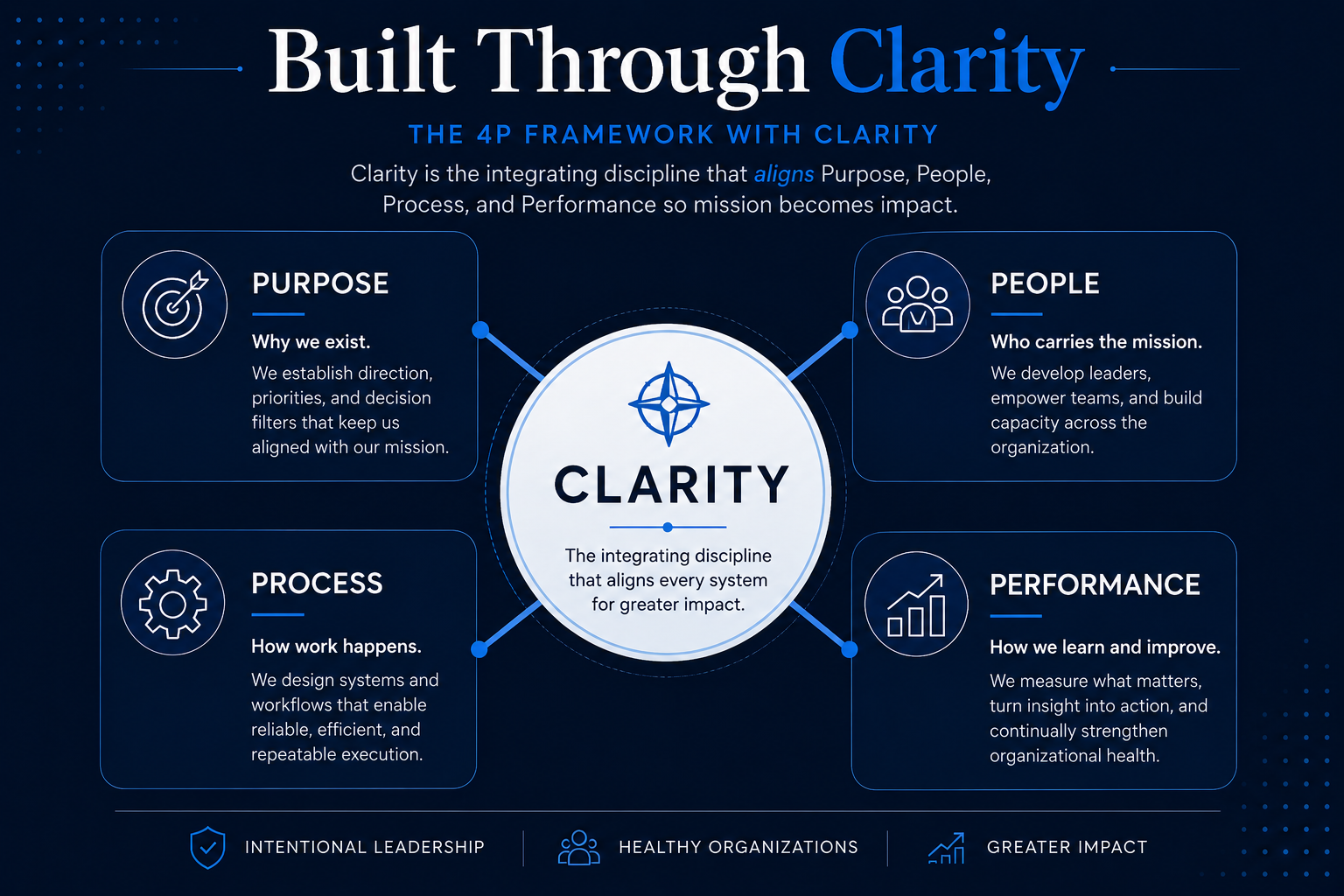
Purpose, People, Process, and Performance are shown as four systems. Clarity is scored distinctly because it integrates and aligns all four.
Purpose
Process
Your first leadership action
Want the complete analysis?
We will email your full Organizational Health Profile across the four systems plus Clarity, all three recommended actions, reflection guidance, and practical resources based on your results.
Three leadership actions based on your response pattern.
See the patterns inside each domain.
How the Organizational Health Assessment works.
The Organizational Health Assessment is research informed and practitioner built. It translates established leadership and organizational practices into a practical operating model leaders can use to see patterns, choose priorities, and take action.
Established practices, not invented leadership science.
The item bank draws from established research areas including goal and role clarity, meaningful work, empowering leadership, psychological safety, coordination, behavior-focused feedback, debriefing, and organizational learning.
A distinct way to integrate the practices.
The assessment organizes those practices through Purpose, People, Process, and Performance, integrated through Clarity. That architecture, diagnostic logic, response patterns, and action mapping are the practitioner-built system behind the tool.
Every question has a reason for being here.
Each of the 50 items is mapped internally to a research construct, the relevant leadership doctrine, diagnostic meaning, common failure modes, and a prescribed leadership action. The goal is to avoid generic quiz questions that produce generic advice.
Scores point to investigation, not labels.
A low score does not prove a root cause or declare an organization unhealthy. It identifies behaviors or system conditions that are less consistently embedded and therefore deserve a closer leadership look.
How scoring works
Each statement uses a four-point, behaviorally anchored response. The intent is to distinguish between an occasional good practice and a practice that has become part of the normal operating system.
Each scored section is normalized to a 0 to 100 score. Purpose, People, Process, and Performance are shown separately. Clarity is also scored, but displayed as the integrating discipline because the model treats clarity as the force that keeps the other four systems understood and aligned. The assessment intentionally does not blend the five scores into one overall organizational health grade.
How the assessment turns scores into help
The results engine looks beyond a domain total. It examines lower-scoring behaviors and subdimension patterns inside the primary opportunity, then surfaces leadership actions mapped to those specific responses. That is why two leaders with the same People score, for example, may receive different next steps if one is experiencing decision dependence and the other is experiencing weak coaching or feedback.
Organizational health and leadership assessment FAQ.
Common questions about organizational health, leadership assessment, scoring, privacy, nonprofits, and how to use the results.
What is an organizational health assessment?
An organizational health assessment helps a leader examine whether the systems around the work are creating clear direction, capable people, reliable execution, useful performance learning, and enough clarity for people to act with confidence. This assessment is a practical leadership diagnostic, not a clinical or financial assessment.
What does organizational health mean in this assessment?
Organizational health means the sustained alignment of Purpose, People, Process, and Performance through Clarity. The goal is not perfection. The goal is to build a system that can carry the mission with less confusion, unnecessary friction, and unhealthy dependence on one person.
What does the Organizational Health Assessment measure?
The assessment examines four systems: Purpose, People, Process, and Performance. Clarity is the integrating discipline that helps keep all four understood and aligned. The assessment includes 10 behavior-based questions for each of those four systems plus 10 Clarity questions, creating five scored sections and 50 questions total.
Who is this leadership assessment for?
It is designed especially for mission driven leaders, including nonprofit founders, executive directors, COOs, operations leaders, senior operators, and leadership teams. It can also be useful in businesses, ministries, churches, associations, and other purpose led organizations. You assess the team, function, department, or organization you directly lead.
Can nonprofit leaders use this organizational health assessment?
Yes. Nonprofit and mission driven leaders are a primary audience for the assessment, especially when growth, limited resources, competing priorities, people development, board or stakeholder expectations, and mission protection are increasing organizational complexity.
Can I use this if I am not the CEO?
Yes. Assess the system you directly lead. A supervisor can assess a team, a director can assess a function, and an executive can assess the organization. The questions are written to focus on the area of responsibility you can actually observe and influence.
How is the Organizational Health Assessment calculated?
Each question uses a four-point behaviorally anchored response: 0 · Not Yet, 1 · Emerging, 2 · Established, and 3 · Embedded. Each scored section is normalized to a 0 to 100 scale. Purpose, People, Process, and Performance are shown as the four systems, while Clarity is shown separately as the integrating discipline. The current methodology does not assume that one blended number accurately represents organizational health.
Why is there no single overall organizational health score?
A single number can hide the pattern that matters. A team may have strong Purpose and People practices while struggling with Process or Performance. Showing each domain separately makes the result more useful for deciding where leadership attention may have the greatest value.
Why is Clarity shown differently from the other four domains?
In the Built Through Clarity Framework, Clarity is the integrating discipline rather than a separate matching system. Purpose sets direction, People build capability, Process creates reliability, Performance creates learning, and Clarity helps keep those systems understood and aligned.
Is this assessment scientifically validated?
Not yet. It is research-informed and practitioner-built. The 50-item bank is mapped to established leadership and organizational research, Eric Boettner's operating doctrine, diagnostic meaning, and prescribed actions. The instrument still requires formal testing for reliability, dimensionality, and validity before it should be described as scientifically validated or predictive.
How long does the leadership assessment take?
Most people should plan for about seven minutes. There are 50 questions, organized into five sections of 10 questions each. Progress is saved locally on the device so you can return if needed.
What happens to my assessment answers and email address?
Your individual question responses remain in your browser by default. If you request the emailed report, the configured email platform receives your contact information, optional context, five section scores, primary pattern, and recommended actions. The production page is designed to connect to Mailchimp without exposing an API key in the browser.
How often should I retake an organizational health assessment?
A practical cadence is after a meaningful period of leadership work, such as every quarter or every six months, and after major growth, restructuring, leadership change, or a significant operating shift. The purpose is to notice movement and choose the next responsible improvement, not to chase a perfect score.
Can my leadership team take the assessment too?
Yes. In the current version, each person completes the assessment from their own perspective. Comparing patterns can create a useful leadership conversation about where perceptions align or differ. A future team version can formalize those gaps without treating disagreement as proof that one person is wrong.